

2025 State of the Market Survey

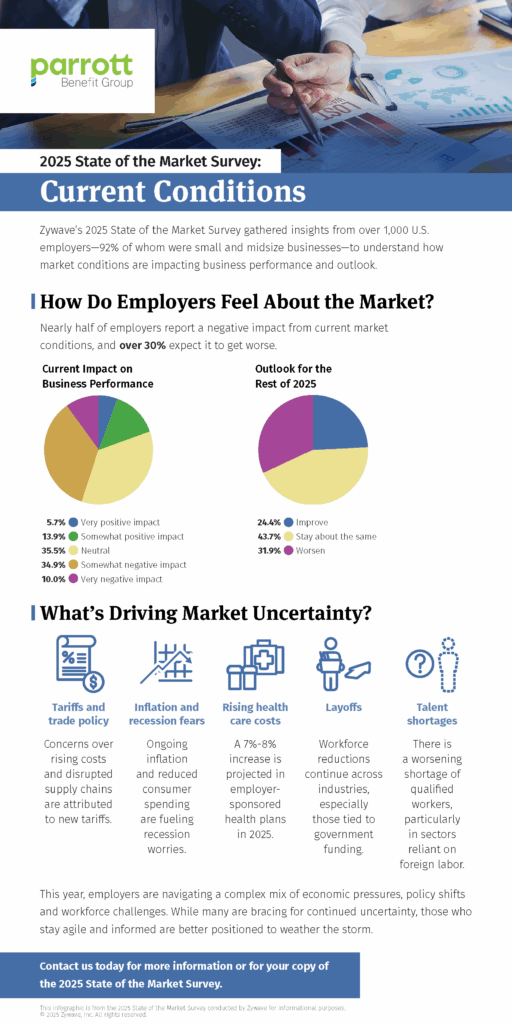
In April 2025, Zywave conducted its State of the Market Survey to gather insights from over 1,000 employers across the United States. The survey focused on the economic climate, workplace challenges, and emerging workforce strategies. Most respondents (92%) were from small and midsize businesses, which employ fewer than 500 workers, and represented a wide range of industries.

This article summarizes the survey’s key findings, providing five general insights into the top challenges employers are facing in 2025.

1. Economic Uncertainty Is the Top Concern

Economic uncertainty was the most frequently cited challenge in the 2025 survey, with nearly 60% of employers identifying it as a top issue. This concern is driven notably by the following factors:
 
  • A new presidential administration introducing policy shifts
  • Ongoing inflation and speculation over a potential recession
  • Tariffs and trade disruptions impacting supply chains
  • Layoffs and budget cuts in certain sectors
Employers are unsure how these factors will affect their operations and are cautious about planning and spending.

2. Inflation and Rising Health Care Costs Are Straining Budgets

Inflation (64.11%) and rising health care costs (42.49%) are among employers’ most pressing challenges in 2025. While inflation has slowed slightly, cumulative cost increases continue to impact organizations of all sizes.
 
Health care costs continue to outpace inflation. According to industry surveys and reports, employers anticipate health care costs to increase by 7%-8% in 2025. As a result:
 
  • Many employers are passing more costs on to employees.
  • Organizations are reevaluating plan designs and wellness initiatives.
  • A growing focus is on educating employees to be better health care consumers.
These financial pressures are forcing employers to find creative ways to manage costs while maintaining competitive benefits.

3. Compliance Challenges Are Growing

With regulatory changes at both the federal and state levels, compliance has become a significant concern for employers. More than one-quarter of respondents (26.7%) cited compliance with new rules and regulations as a top challenge.
 
Key compliance concerns include:
 
  • Changes in federal employment laws (24.6%)
  • Increased agency enforcement (15.5%)
  • Shifting diversity, equity and inclusion policies (12.7%)
  • Immigration-related enforcement (10.9%)
Employers are working to stay informed and agile in response to these evolving requirements.

4. Attraction and Retention Challenges Persist

Although the labor market has stabilized somewhat, attracting and retaining talent remains a major issue for nearly 60% of employers. Most expect these challenges to stay the same throughout 2025.
 
To address this, employers reported they’re implementing the following top five strategies to improve attraction and retention efforts:
 
  1. Focusing on employee engagement through cost-efficient engagement programs (e.g., flexible work arrangements and recognition programs)
  2. Raising compensation to stay competitive
  3. Offering learning and development opportunities, such as mentoring, career pathing and focusing on skills related to artificial intelligence
  4. Redesigning onboarding programs to improve early employee experiences, such as new hire orientation
  5. Using skills-based hiring to expand the talent pool beyond traditional qualifications such as education and certifications
These strategies reflect a shift toward more employee-centric approaches to workforce management.

5. Employers Are Focusing on Strategic Workforce Planning to Win and Keep Talent

Attraction and retention is not the dire workplace challenge of recent years. In fact, “labor market changes” is the No. 4 top business challenge, right behind inflation, rising health care costs and tariffs. As such, many employers are taking proactive steps to adapt and compete in the race for talent. According to the survey:
 
  • Three-quarters (76.6%) of employers have posted job openings or hired new employees in the past six months.
  • Most organizations are not scaling back hiring, indicating cautious optimism.
  • Employers are increasingly aligning workforce strategies with long-term business goals.
Organizations focusing on efficiency, engagement and adaptability are more likely to succeed in today’s uncertain environment.

Conclusion

The 2025 State of the Market Survey highlights employers’ complex challenges, including economic uncertainty, inflation, compliance, and talent management. Employers can position themselves for success in a rapidly changing market by staying informed, focusing on planning and remaining agile to meet employee needs.

Contact us today for more information or for more workplace resources on attraction and retention, benefits, or any topics discussed in these survey results. 

This article is not intended to be exhaustive nor should any discussion or opinions be construed as professional advice. © 2025 Zywave, Inc. All rights reserved.

Author